Showing posts with label Philosophy. Show all posts

Saturday, January 8, 2011

Journey on the Big Sur


Journey on the Big Sur

-- Sesameboat


This December has been wet. When the five day shower finally came to an end, a mini pond has formed around our house. Tomato plants lay blackened and drowned in the front garden; our cats spent their days crowded motionlessly in the half soaked bed, casting long gazes on the back yard walls, which seemed to be shedding colors in the rain. The whole Santa Barbara blurred up as a painting tarnishes in water. The sky grew leady, the ocean grew pale; the redness of the roof tiles, the greenness of the roadside shrubs, together with countless other hues slowly oozed into one another, making the town look even darker. It is only towards the end of the month when the weather finally started clearing up. Having been stuck at home all this time, a brief traveling seemed to us the best way to welcome the New Year.

And so we did. On the brink of the New Year, we hopped in our car and headed north along Highway 1. The trip took around five hours each way. Our destination was Carmel-by-the-Sea, a tiny town tucked between the rocky peaks and the wavy coastline of El Sur Grande – the Big Sur.

Elephant Seal Beach

One of the first attractions along this route was the Elephant Seal Beach near the town of San Simeon. Early spring to late summer is the breeding time for elephant seals. During this period, they are more likely to stay ashore nursing the babies than fishing in the sea, and we were just lucky enough to bump into the scene: hundreds of these huge sea mammals scatter on the soft sand. Male elephant seals looked rather like beach rocks with their dark wet skin and rotund bodies. The females, though, had quite a different appearance. Ivory-silver colored and much smaller in size, they looked like youngsters at a first glance. Watching them nap on the sand was quite funny – it reminded me of our cats, for they, too, slept with tummy facing upward and whiskers twitching in dreams.

The real elephant seal babies, wrinkled, black and helplessly cumbersome, snuggled up and cried to mom for milk from time to time. As I stood there watching the heart softening scene, I noticed a faint odor mixed in the salty sea breeze. It got stronger so it seemed, when we walked up along the shore.

Suddenly I caught a glimpse of a gull pecking the small body of an elephant seal. It was a dead baby, from starvation or illness we don’t know. There amidst the nursing moms and the gulping newborns, the dead baby seal itself was the feast of another species. The subtly repugnant smell probably came from the slow decay, as the weather was chilly here in San Simeon. I tried to locate the mom – just feet away all the seals were busy feeding or resting, nobody seemed any different.
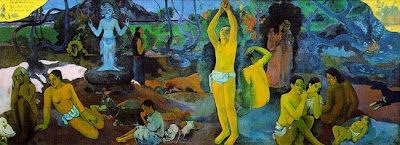
In his masterpiece Where do we come from? What are we? Where are we going? Paul Gauguin had made the everlasting quest on life and death by putting the newborn, the youth and the old woman, crying or brooding, excited or confused together on one scroll of heavy colored painting. I had a flashback of th

is piece, and couldn’t help feeling that even a genuinely talented artist like Gauguin came across pitiable when compared to Nature herself.

Nature paints the scroll of life and death every day with such beauty, cruelty and ease. Creatures such as seals don’t quest. Embodied with the rich vigor of life, they fit unawares in our world as Gauguin’s flat figures on his canvas.

Waterfall House
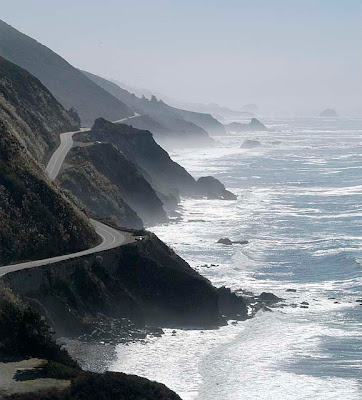
The road got curvier shortly after the Elephant Seal Beach. Hence we entered among the peaks of Santa Lucia Mountains. Mark and I started looking for a word that could rightly describe this territory -- “Stately” seemed too pretentious; “Magnificent” seemed too vague; “Lofty” failed to capture the masculinity, while saying they are merely “masculine” would have missed a very important point: these mountains were solemn and imposing: Cliff lines that plunge deep into the ocean were half veiled in a transparent mist, and valleys so shadowed by dark pine trees close in on the narrow highway at times, before abruptly retreating, revealing the vast open sea over the next turn. Santa Lucia Mountains did not come across as a hiking friendly place – not merely for safety concerns, but more because of a feeling – as if doing so is to intrude, to disturb, as if these mountains deserve more respect than that.

Even the reeds looked different. They were much tougher here than the ones growing on wet land or by ponds. Instead of bending and waving in the winds, these reeds thrust up towards the sky like disarrayed arrows and swords. They gave us a weird feeling of having stumbled upon a deserted battlefield – the blood once shed long darkened, the roar once resonated long faded, the cause once died for long forgotten, leaving behind only millions of arrows on the lonesome cliffs. Santa Lucia was, in that sense, a forlorn place. The occasional electric poles by the cliff side were the only thing that reminded us of modern inhabitation.

I’ve always wondered about those pioneers who, driven by the Homestead Acts, first ventured into this daunting wildness. What was it like to live on the cliff along the coastline, greeted by the Pacific Ocean every morning, threatened by rock slides every night? What was it like to set up ranches at a place without roads, without power, and over years hoping to prove to the state government that the land you lived on was “improved”? How many people succeeded, and how many failed?

Somewhere along the way stood a sign called Waterfall Vista, and it was here we decided to take our first stop for a walk. The trail ran parallel with a quiet creek, curving its way amidst the thick redwood forest. Then it led to a short tunnel that went underneath the highway we just drove on. At the end of the tunnel, all of a sudden, we found ourselves standing on the outside of a cliff, directly facing the ocean and the beach.

And what a beach.

It was breathtakingly beautiful, even to the eyes which had been accustomed to the grand scenes of Big Sur. Here the ocean adopted a crystal green hue, as emerald held in the sun. Huge surrounding rocks with leaning cypress and pines defined a small patch of silver sand, which gently dipped into the green water like a child’s palm. Right at one corner, an eighty feet waterfall flew down the cliff and smashed onto the beach, creating a mist that was joined, from time to time, by the foaming high tides.

The Waterfall Beach looked unworldly and delicate, as Eden looked in Paradise Lost. Right underneath the fall, I see Eve rinsing her long flowing hair, and naked Adam sunbathing by the rock at ease. If there were a place that made you forget all the mundane worries, it would be right here, on the Waterfall Beach. We stood there long at lost, on the trail that hangs on the cliff, looking down at the silver sand. The beach was inaccessible, as such an unworldly place should be.

The trail led to a platform with a couple wooden benches, and, oddly enough, the base of some piled-rock walls. The view here was splendid, with Waterfall Beach to its left, Santa Lucia valleys as its backyard, and the vast green Pacific at the doorstep. On a small peninsula now overtaken by wild cypress, I could see layers of pebbles that outlined what seemed once to be a huge garden.

Here indeed, once stood a mansion, owned by a former congressman and his wealthy wife, donated to the State of California upon his death -- for she had hoped to turn it into a museum of Indian relic -- and eventually torn down after her death.

Who is not to feel a bit empty, roaming on such a ruin? -- “For dust thou art, and unto dust shalt thou return.”

Carmel-by-the-Sea – a Nouveau Riche’s Bohemia

I have always been a fan of the Bohemian artists. Among them my favorite one is Modigliani, a young Italian painter who suffered from lung illnesses since childhood, thus forced away from his beloved sculpturing into oil painting. Throughout his life, Modigliani rarely ventured into landscape. His most famous pieces are mostly portraits.

It might have been a warm afternoon, more than ten years ago, in the huge and dusty library in Peking University. I sat there slowly flipping pages through Modigliani’s biography and portraits, greeted from time to time by necks long and thin, faces stretched and pale, eyes narrowed and yearning. The unique distortion bares resemblance to sculpturing, revealing, I thought, the painter’s own distorted yearning for the art of sculpturing.

That thought gave me a sharp sense of pain, for it reminded me of the lonely and odd life I was living. As a physics student, I never quite understood my own field, and never quite fit in scientists. What excites them always bores me deeply. For years I’ve yearned to be a writer, gulping down novels and poems at the expense of studying.

I didn’t belong to the aggressive group of overachievers of course, neither did I belong to the cool group of slackers – while they were busy partying, I was buried in the Humanity section of the library, working harder than a literature major – for nothing. Left in between the cracks of Arts and Science, I may have appeared weirder to my classmates than the distorted faces in Modigliani’s portraits.

Thus the word “Bohemian” found its way into a soft spot in my heart. I felt intimate to the concept – being a Bohemian is not about walking down a crowded street with wild hair and weird costume just so you’d appear avant-garde. Rather it’s about being different, ignored, and lonely.

Without that piercing loneliness, there wouldn’t be such a thing as Bohemian. Art is a most personal belief; it drives one into the abyss of individuality. Things that may appear crucial to others – acknowledgments, companionship and even the sense of social dignity all seem dispensable when, fortunately or unfortunately, the nymph of Art casts her gentle spell on you.

Bohemian as a trend is a ridicule to the word itself. It grew into the worst nightmare when the so-called Bohemian legacy was left among the wealthy – in a country untouched by aristocracy, where the short roots of wealth trace back to no other groups than businessmen and celebrities.

Carmel-by-the-Sea might once have been a paradise for artists with true talents; nevertheless it is a very different town now. It is one of the most expensive as well as ostentatious towns in U.S. – a Bohemia according to the nouveau riche.

Everything about Carmel was so quaint and classy: layers of gray wooden roofs dance in the arms of the redwood forest dense; numerous art galleries turned Ocean Avenue into an exquisite necklace. Along the seventeen-mile-drive lie the world’s most luxurious golf courses, while neighborhoods with dreamy backyards lead to the dog friendly beach.

Such appearance did remind me of a small European town, take Genoa for example – reclusive, subdued yet rich with history, it’s the kind of place where outcasts lead their own slow lifestyle. But then I thought of the vast golf course by the sea, and couldn’t help noticing that land here is ridiculously expensive, even to the California standard, driving hotel prices sky high and making a local store that doesn’t sell Jewels or Art impossible to afford its rent.

And that is not European at all, nor is it truly subdued and quiet. One of my favorite things in Genoa is to roam along the narrow alleys at night, watching doves resting on the long clothesline, and shirts and skirts waving in the soft lamplight. Deep down the alleys there often was a mixed smell of sweet climbing rose, salty fish net with a faint trace of cat pee. Those bumpy Genoa alleys connect cheap restaurants offering fresh pesto and porcini, tiny markets with local olive oil and salami before joining into Piazza de Ferrari, a grand square with more than a thousand years of history. Deep culture and vital tradition, rather than expensiveness backed up the charm of Genoa.
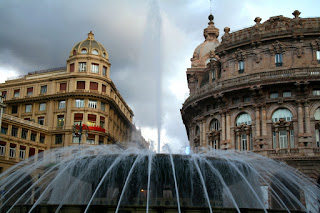
So, back to Carmel. How is a local artist supposed to afford living here, unless he or she has been tremendously successful already? The retired investment bankers love decorating their social life with well known artists, same way as Carmel ladies like to wear huge diamonds – in a Bohemian style that is.


Wednesday, June 3, 2009

451 to Atlas


Song of the Day: Atlas Shrugged - Jeff Sipe

Quote of the Day: "The zipper displaces the button and a man lacks just that much time to think while dressing at dawn, a philosophical hour, and thus a melancholy hour." --Beatty, from Ray Bradbury's Farenheit 451

Thought of the Day: Just finished Ray Bradbury's Farenheit 451, what a wonderful book. The book that pumps you up about reading books. Set in the future, in a time and place where books are banned and government censorship rules. The firemen of the future, including main character Beatty, set fires instead of putting them out. Their most popular target: those curious thinking rebels who still keep books in their hidden home libraries contrary to the rule of the land. Solution: burn the books, the houses, and sometimes the book-readers themselves.

In this future dystopia, government censorship means no literature, no teachers, no creative individual thought. Its replacement is 'the family' which in actuality is more like mass entertainment. 'The family' is our current TV and youtube culture combined and on crack. The hapless populace assemble in their parlors, which are rooms with full-wall media screens where fast moving images of cartoons, soundbite sensationalist news, and cheap pulp fiction are offered like an all-you-can-eat buffet for convenient in-home standardized mass consumption.

The themes of the book, written over 50 years ago, still run quite true. How far are we from this picture today, where the population is more concerned with who will be the next American Idol than with the often destructive policies of our short-sighted politicians? The elected leaders love our pre-occupation with professional sports teams and mind-numbing reality television shows. No need for overt censorship in this age as the populace is content to ignore the goings on in Washington unless it is an election year and only if the complex news is filtered down to catchy slogans like 'Change' and 'Hope'.

After finishing 451 I immediately cracked open a new novel, Ayn Rand's Atlas Shrugged. In this sprawling work Rand details her own philosophy, dubbed Objectivism, and asks the question: "Who is John Galt?" The Song of the Day references the work it it's title. Not sure of the connection, but it's a pretty song. I'm already enjoying the book immensely and will likely post on it as I read more.

Cheers, Dr. Kowawa

Friday, May 8, 2009

Ceci n'est pas un message


Song of the Day: Dream - John Cage

Quote of the Day: "How can you tell if your own logic is 'peculiar' or not, given that you have only your own logic to judge itself?" --Douglas R. Hofstadter, from Godel, Escher, Bach

Thought of the Day:

My thoughts these last couple of days have been with the people of Santa Barbara, CA as the wildfires continue to blaze. Fortunately there have been no deaths but some firefighters have been injured and there has been substantial loss of property. May the blaze be contained soon with minimal further damage.

Of late have been continuing reading Godel, Escher and Bach, and am on the final chapter. This has been an extremely rewarding, though quite challenging, read. The quote of the day is a really interesting one from Hofstadter. Love this loop of questioning. The Song of the Day is from John Cage, whose work is frequently mentioned also in the book. The pic at the top is from Magritte, who challenges viewers of his works to question the reality of representations or symbols. In this piece he highlights that the reality seen through the window is represented on the painting, and the viewer takes another step back to see that this representation is itself a painting on a canvas. Which is itself also a further two-dimensional reality-representing symbol, the one the viewer is witnessing. Take it back a step further by interpreting the whole visual concept a la the philosophy of Descartes . . . Here is a quote from Magritte on this work:

"I placed in front of a window, seen from a room, a painting representing exactly that part of the landscape which was hidden from view by the painting. Therefore, the tree represented in the painting hid from view the tree situated behind it, outside the room. It existed for the spectator, as it were, simultaneously in his mind, as both inside the room in the painting, and outside in the real landscape. Which is how we see the world: we see it as being outside ourselves even though it is only a mental representation of it that we experience inside ourselves."

Tuesday, May 5, 2009

Tao Te Ching

This weekend decided to do a 56-hour fast (apples & tea allowed) and to re-read / study the great classic Tao Te Ching. First, wanted to share a link to the actual edition that I am using, which I think is excellent for several reasons. First, it is a beautiful hard-cover book with very tasteful illustrations. Second, according to Sweewawa the translation to English is favorable to some of the other versions currently in print. I would strongly recommend this version to anyone who is interested in purchasing the book or checking it out from the library. You can get it from this link to Amazon, or at the time of writing this version is available at Barnes & Noble, believe it or not in their Bargain books section!

Tao Te Ching
Translated by Man-Ho Kwok, Martin Palmer, and Jay Ramsay
Calligraphy by Kwok-Lap Chan


Here is a brief outline of the timeline of Chinese philosophy:

•The Classical Age (6th century BC-2d century AD)

–Confucianism (Confucius, 551-479 BC)
Daoism (Lao Tzu, 6th century BC)
Mohism (Mo Tzu, 468-376 BC)
–The Yin-Yang School (founder unknown)
–The School of Names (Logic) (Hui Shih, c. 380-305 BC)
–Legalism (Han Fei Tzu, d. 23 BC)

•The Medieval Age (2d-10th centuries BC)

–relations & conflicts between Confucianism, Daoism, & Buddhism

•The Modern Age (11th century AD-Present)

Neo-Confucianism (incorporation of Daoist & Buddhist elements in an overall Confucian perspective) (Chu Hsi, 1130-1200 AD & many others)
–20th century impact of Western philosophies such as Pragmatism & Marxism

I would like to highlight some of my favorite passages of the work and offer some comments.

Introduction

    The translators / editors emphasize that the Tao Te Ching was not written solely by its supposed author, Lao Tzu. Rather it encompasses texts which probably cover 800 years. This is a crucial point in my view. Another interesting point made in the introduction is that in many ways the Tao Te Ching represents an opposite view from K'ung Fu-tzu (Confucius) philosophy but in some ways Taoism and Confucianism are very similar.

    The book is made up of 3 sections. The first consists of Chapters 1-37 and is the Tao, or "the Way". According to the translators this section contains the core of Tao Te Ching's message. The second part consists of Chapters 38-70 and is the Te, or "the Virtue". This part plays a supportive role to the original message of "the Way". The third part the translators interpret as a "Coda", Chapters 71-80. In this section a lot of the themes presented in the rest of the book are reiterated. It is arguable that the quality of the text declines for this last section.

Chapter one


"The Tao that can be talked about is not the true Tao."

    I love the humble way the book begins. Right from the start the author acknowledges that one cannot truly represent the purity of Tao via finite words with their inherent limitations.

"Everything in the universe comes out of Nothing."

    It is interesting how this statement has parallels in the modern science of Big Bang Cosmology. According to the Big Bang theory, all the mass contained in the universe now, trees mountains moons stars and all, originated from a single point of miniscule (or no) volume containing infinite (or all) the mass.

Chapter two


"Beauty and mercy are only recognized by people
  Because they know the opposite, which is ugly and mean."

    This is such a powerful concept. Lao Tzu has a special appreciation for the slip side of the coin -- the "bad and ugly" -- and sees their value, in a way, as on par with "the good". This is a tough concept for Westerners to get, as we in religion and culture often hold "the good" on a pedestal while sweeping "the bad" under the rug or dismissing it solely as the realm of the devil. One of the challenges I hope to meet in studying Taoism, Confucianism, and Buddhism is to learn how to acknowledge the good and bad present in all things while still striving to accomplish what I perceive as "good" in my actions.

Chapter four


The Tao " . . . smooths round sharpness
                      and untangles the knots."

    Such a beautiful quote. In physics and science there is the concept of entropy, or disorder. The second law of thermodynamics is an expression of the universal law of increasing entropy, stating that the entropy of an isolated system which is not in equilibrium will tend to increase over time, approaching a maximum value at equilibrium. This means that the universe is not unlike the room of a child, which gets messier with each passing day. I see this concept of increasing entropy present in the rounding of sharpness and the untangling of knots. But note though that often smooth jewelry is considered more "perfect" and desirable, and that hair without knots is actually considered neater or more ordered, though it may in fact have a higher entropy value. I love it that this quote can be interpreted in opposite but equally profound ways. Another really neat concept is that of planets. It is thought that all planets and moons probably started out as quite irregular shapes but the forces of air resistance and gravity over great periods of time caused them to become basically spherical.

Chapter five

"Heaven and earth are like a pair of bellows:
  they are empty, and yet they can never be exhausted."


    How can something come from nothing? What is so meaningful about emptiness and nothingness? The Tao Te Ching explores these questions again and again. I love the choice of words to end the quote -- note the dual meaning of "exhausted" as tired out but also contributing to the image of bellows "exhausting" or emitting puffs of air to fan the flames.

Chapter seven

"The sage guides his people
  by putting himself last.

  Desiring nothing for himself,
  he knows how to channel desires.

  And is it not because he wants nothing
  that he is able to achieve everything?"

    I really appreciate the last lines of this passage from a utilitarian perspective. One of the nagging thoughts that has in the past drawn me away from continuing studies in Tao and Buddhism is the sense that while it is beautiful and profound it lacks utility in everday life. In my life I don't really just "go with the flow" but rather I am always actively working and struggling to carve out a straight path towards my goals -- for example becoming a great Radiologist. This is a little different from the free spirit who wanders the earth and experiences that which comes his way. I love talking about vague concepts such as "Nothing" and "the Way" but do sometimes appreciate a tip of the hat towards the practical value of studying a particular philosophy.

Chapter eight


"Water, you know, never fights
  

  it flows around
                               without harm."

    I find this to be a beautiful way of describing the concept of pacifism without suggesting that it is a weakness. Note the photo is one I took at Lushan mountain, near Sweewawa's hometown in Jiangxi province of China.

Chapter nine

"You may amass gold and jade in plenty
  but then the more you have, the less safety . . . "

    This is sage advice on the dangers of gluttony and greed. Note also that this is an example of good and bad being equally contained in all things. Newton's third law is that "for every action there is an equal and opposite reaction." This is yet another example of how Tao concepts are often mirrored in science!


Chapter eleven

This is one of my favorite chapters so far, and I think this particular translation is excellent! Here's the whole of the chapter:

                                Thirty spokes on a cartwheel

              Go towards the hub that is the centre

- but look, there is nothing at the centre
and that is precisely why it works!

If you mould a cup      you have to make a hollow:
it is the emptiness within it that makes it useful.

In a house or room      it is the empty spaces
- the doors, the windows - that make it usable.

They all use what they are made of
to do what they do,

but without their nothingness they would be nothing.

**************************************************

    I love the concept that it is the emptiness, and space that makes things useful. Empty space is also a really important concept in music. Often it's the notes you leave out that truly make a piece of music beautiful. This concept is exemplified masterfully in the Miles Davis composition "In a Silent Way". Miles is really good at creating space in his music, and the space is what makes the tune "something".


Interestingly, Miles once was quoted as saying: "Don't play what's there, play what's not there" which I feel to be the perfect yang to the empty space's yin.

Chapter twelve

"The five coulours
                                 blind the eye -

The five notes
                             deafen the ear . . .
The five tastes
                            deaden the mouth

[ . . . ]

The sage [ . . . ] is guided
                                       by his instinct

and not by what his eyes want."


    Reading this I'm drawn back to my readings of Descartes, who believed that true sense perception was more dependent on the mind than the body. He argues that sense can fool, as in the case of watching a candle melt. Is "candle" a liquid, solid, or a fire? The only true understanding of its nature is arrived at by realizing the senses are just hints or clues about what is true . . . and using the mind to connect the dots. Descartes says "[P]erception . . . is neither a seeing, nor a touching, nor an imagining . . . [r]ather it is an inspection on the part of the mind alone."

Chapter thirteen

"If you can put yourself aside -
  then you can do things for the whole of the world.
  And if you love the world, like this
  then you are ready to serve it."

Sage advice especially for ultra-competitive and ambitious me.

Chapters fifteen - nineteen

These chapters talk about what it takes to be a good ruler. An interesting concept described is that the best government is one that is not seen at all:

       "The highest form of government
  Is what people hardly even realize is there

[ . . . ]

  And the people stay happy
  Believing that what happens
                                                     happens, naturally."

  
    First, I definitely don't take this to mean that the people are being deceived or that the details of governing are being hidden from public view. Rather, the Tao Te Ching in my view suggests that good governing should be more like the laws of nature, mysteriously and silently telling the trees which way to grow and the rivers how to flow to the sea.
    How does this concept relate to modern politics? It's my view that free market capitalism with wise & minimal regulation fits well into this picture. A mountain spring will trickle down via tributaries to the river and then the sea, provided you let it. The forced welfare state, in contrast, oppresses people by taking them out of their natural state. The "benevolent" ruler in a welfare state is very visible, and those receiving aid are felt drawn to leave their own natural forces of survival and self-betterment to fly like moths towards the new artificial light.

Chapter twenty

"Is there really much of a difference
  Between being angry and pretending not to be?"

As Shakespeare would put it "be true to thineself." I believe it to be one of the most important lessons there is in life.

Chapter twenty-one

(Note the accompanying photos are ones I took at Lushan Mountain in China (near Sweewawa's hometown) of a shrine to Buddha.)

  This edition / translation of the Tao Te Ching is one Sweewawa and I picked partly due to the fact that it overall depicts very well in English the original intent and beauty of the Chinese text.  However, the translation is by no means perfect.  This chapter is, in my view, one example of the imperfection of the translation.  To illustrate my claim I quote first the translation of the chapter in its entirety followed by an alternate translation by Sweewawa.

  From these two versions you can catch a glimpse of how radically different translations of the Tao Te Ching can be.  The difficulty lies in the fact that a very literal translation of the text will be clumsy and much of the desired meaning would be lost due to the fact that the English-speaking reader will lose subtle cultural references and other subtleties of the language.  So for a great translation a certain amount of creativity is required.  But there also is a danger in being creative of straying away from the intended meaning.

  The ninth line of the book's translation is "I say so, and I can prove it!"  This line when I first read it caused my hair to stand on end and I read on with great interest.  This is quite a bold claim contained within a book with groundings in religion and philosophy  . . . but after finishing the chapter I was disappointed.  "How do I know the Tao is the root of all being? . . . Because I know this."  I never would have asked for such a thing as a proof that the Tao is the origin of all things, as this is, I think, such a undefinable and unprovable concept that if one believes one must only hold based on faith.

  Sweewawa's translation speaks to me much more.  "God" or "Tao" are words and concepts that have been around for eons.  Just that is in a way a "proof" that there is something real behind the words . . . "From the Ancient time until now, its name has never perished."  But this is not a proof in the sense that you can say "I can prove it!"  Sweewawa offers the translation "At the bottom of the dark abyss, there is an essence.  The essence is so real, you can rely on it."  I do believe or "rely" on the idea that there is a "God", "Tao", or "Creator" who exists outside the universe and is the source of all things we know.  This concept is in a sense obvious to me, but yet I realize it is absolutely unprovable.  This is the beauty and difficulty of the "faith" concept present in many religions.   You cannot prove it, but you rely on it.      

Book translation:

The Body of The Tao
                                       is a mist beyond your eyes.

Tao of No Body,
                              and yet within it is All Creation.

Like a seed in the dark, and a dim light
     And from it, comes everything.

Root, stem, leaf . . . its essence is in everything.

Everything is born from this Tao

                                  I say so, and I can prove it!

From the beginning of time until now
the Tao is eternal because it is Creation.

How do I know the Tao is the root of all being?

Because

                 I know this.

Sweewawa's translation:

The biggest virtue obeys nothing else but Tao.
  Yet Tao reveals itself in an obscure way.

Behind the fleeting sceneries, there is an image.
  Behind the vague phenomenons, there is an object.
    At the bottom of the dark abyss, there is an essence.
      The essence is so real, you can rely on it.

From the ancient time until now, its name has never perished.
  It is the origin of all things.

How do I observe the beginning and development of all things?

    Because I know Tao.

Chapter twenty-four

"The kind of person who always insists
  on his way of seeing things
  can never learn anything from anyone."

This is great advice about the benefits of keeping your eyes, ears, and mind open.

Chapter twenty-five

  This chapter contains language which paints "Tao" as a very "God"-like being.  In it the Tao is described as "Mother of Everything", "greater than everything", "Tao is Great", "It is greater than Heaven, Greater than the Earth, Greater than the king."  I found it incredibly interesting (and satisfying) to see that Lao Tzu (and the other authors) took this stance on describing the Tao.  The Tao, according to them, is not just everything itself but is the source and master of everything.  This hierarchy is one that resonates with me personally and jives with the basis of the Christian faith to which I am accustomed.

To be continued . . .

Wednesday, April 1, 2009

Day and Night


Song of the Day: Castles Made Of Sand - Jimi Hendrix

Quote of the Day: "Knowledge speaks, but wisdom listens." --Jimi Hendrix

Thought of the Day: I have been really enjoying reading more of Hofstadter's Godel, Escher, and Bach book. I am now approaching half way through. Now am continuing to learn a little more about Zen through the book. Was struck by this neat concept presented in the book: that an ultra-concise summary of "enlightenment" would be . . . transcending dualism. The world is made up of night/day, happy/sad, self/non-self, life/death . . . or is it? I love how in the M.C. Escher woodcut shown above Escher blurs the distinction between duality. To mentally accept this painting one has to abandon the idea that it is night OR day. It is both. Similarly perhaps there is good and bad contained in all things, and in fact even "all things" are just one.

One of the really weird concepts to get around in studying Zen is that it's not meant to be studied. To commit the Zen concepts to words is challenging the duality. It's really interesting that perhaps one of the reasons Zen didn't become a powerful movement like Christianity is that its "preachers" actually resisted putting words about Zen on paper to spread to others. One Zen student once asked, if Zen eschews intellectualizing it, then how am I to study and learn it? The student was given the response that any path towards understanding Zen is equal. If the student wished to use intellectual study as his path towards Zen, then part of the process of reaching enlightenment would be to fall away from this chosen path. Quite a concept.

One of the modalities used in "teaching" zen and helping students reach enlightenment is the koan, which are stories like the one I presented in my last post. These stories do not have self-evident "morals" at the end but rather bring the audience to a state at which they can appreciate reality from a new perspective, perhaps by abandoning previously held views. I have always been struck by the lyrics of Castles Made of Sand by Jimi Hendrix, shown below. Was he a modern-day Zen practicer? These lyrics feel to me like a koan.

Down the street you can hear her scream you're a disgrace
As she slams the door in his drunken face
And now he stands outside
And all the neighbors start to gossip and drool
He cries oh, girl you must be mad,
What happened to the sweet love you and me had?
Against the door he leans and starts a scene,
And his tears fall and burn the garden green

And so castles made of sand fall in the sea, eventually

A little indian brave who before he was ten,
Played wargames in the woods with his indian friends
And he built up a dream that when he grew up
He would be a fearless warrior indian chief
Many moons past and more the dream grew strong until
Tomorrow he would sing his first war song and fight his first battle
But something went wrong, surprise attack killed him in his sleep that night

And so castles made of sand melts into the sea, eventually

There was a young girl, whos heart was a frown
cause she was crippled for life,
And she couldn't speak a sound
And she wished and prayed she could stop living,
So she decided to die
She drew her wheelchair to the edge of the shore
And to her legs she smiled you won't hurt me no more
But then a sight she'd never seen made her jump and say
Look a golden winged ship is passing my way

And it really didn't have to stop, it just kept on going...

And so castles made of sand slips into the sea, eventually

Friday, March 27, 2009

Now and Zen


Song of the Day: West Coast Blues - Wes Montgomery

Quote of the Day: "Chance favours the prepared mind." --Louis Pasteur

Thought of the Day: The song of the day is one of my favorite Wes Montgomery tunes, love his soloing on this track. I played guitar on this tune a few times with my old jazz group, the Jazz Action Committee. Sweewawa and I have lately been debating about the merits of organized religion, and have as part of this discussion been sharing some Zen stories. Over the couple of years I'm eager to explore further the ancient philosophers thoughts on organized religion and also to delve into studying Zen Buddhism. I hope in these continued studies / discussions to arrive at a shared "conclusion" about what role spirituality will play in our lives. For starters I'll share now on this blog a cool Zen story I just encountered:

A man travelling across a field encountered a tiger. He fled, the tiger after him. Coming to a precipice, he caught hold of the root of a wild vine and swung himself over the edge.

The tiger sniffed at him from above. Trembling, the man looked down to where, far below, another tiger was waiting to eat him. Only the vine sustained him.

Two mice, one white and one black, little by little started to gnaw away the vine. The man then saw a luscious strawberry near him. Grasping the vine with one hand, he plucked the strawberry with the other.

How sweet it tasted.

Cheers, Dr. Kowawa

Monday, March 23, 2009

Forms within forms


Song of the Day: In A Landscape - John Cage

Quote of the Day: "The more powerful and original a mind, the more it will incline towards the religion of solitude." --Aldous Huxley

Thought of the Day: Today begins my Spring Break, and I spent a good part of it reading Godel, Escher, Bach. Encountered during my reading the awesome Escher piece shown above. The forms within forms concept illustrated in the woodcut is really cool, and has some basis in reality, as genotype DNA which is the blueprint for our whole self, or phenotype, is contained within each individual cell. Also during my reading encountered some descriptions of musical offerings by John Cage, a modern musician who championed the concept that randomness and chance in music could be beautiful. He commented that he would like "to let sounds by themselves, rather than vehicles for man-made theories or expressions of human sentiments." The song listed above is not so much random (it does have considerable melody), but it is a selection I encountered on exploring Cage works to which I was particularly drawn. Hope you enjoy it too.

Cheers, Dr. Kowawa

Tuesday, March 17, 2009

Happy 100th post!


Song of the Day: The Musical Offering, BWV 1079 - Ricercar a 3 - Johann Sebastian Bach


Quote of the Day: "Employ your time in improving yourself by other men's writings so that you shall come easily by what others have labored hard for." --Socrates

Thought of the Day: Recently began re-reading a favorite book: Godel, Escher, Bach: An Eternal Golden Braid (A Metaphorical Fugue on Minds and Machines in the Spirit of Lewis Carroll). This is a brilliant book which describes the shared patterns of beauty found in works of Math (Godel), Art (M.C. Escher), and Music (J.S.Bach). My song of the day today is J.S.Bach's Musical Offering, a masterpiece which is built around the musical (and somewhat mathematical) concept of the "canon". The "canon" is essentially taking one pattern and shifting it around (delaying it in time, speeding it up, modifying starting pitch, "inverting" it, etc). The superimposed parts create beautiful harmonies. The genius of Bach, in my view, is that he was able to create such complex mathematical patterns in his music without having the works sound formulaic or boxy. Also amazing is that he was able to improvise multi-part cannons on the spot, a tremendously difficult mental exercise!

Cheers, Dr. Kowawa

Sunday, March 1, 2009

Snowy snowy night

Songs of the Day: Winter Wonderland - Tony Bennett

My Favorite Things - Tony Bennett

Quote of the Day: "Watch your thoughts; they become words.
Watch your words; they become actions.
Watch your actions; they become habits.
Watch your habits; they become character.
Watch your character; it becomes your destiny." --Lao Tze, Chinese philosopher from 6th century BC

Thought of the Day: Writing this eve in front of a warm fire. Outside Richmond is being blanketed by a thickening layer of white snow. Quite a rare treat for Richmond in March. Wish I were on the slopes now . . . and am hoping tomorrow might be a "snow day".

Wednesday, August 27, 2008

Plato on Veins

Song of the Day: Vein Melter - Herbie Hancock

Quote of the Day: "Now after the superior powers had created all these natures to be food for us who are of the inferior nature, they cut various channels through the body as through a garden, that it might be watered as from a running stream. In the first place, they cut two hidden channels or veins down the back where the skin and the flesh join, which answered severally to the right and left side of the body. These they let down along the backbone, so as to have the marrow of generation between them, where it was most likely to flourish, and in order that the stream coming down from above might flow freely to the other parts, and equalize the irrigation." Plato, Timaeus 77.d

Thought of the Day: Today had a very fulfilling time working with the non-Invasive Cardiovascular Radiology team. We encountered a patient who was a renal donor candidate, and found some (asymptomatic) anomalous venous vasculature on doing Magnetic Resonance and CT studies. I plan to do a presentation on the findings for the team, and found the above quote from Plato quite relevant for the project.

Sunday, June 1, 2008

The Butterfly Philosopher

One morning Chuang Tzu awoke from his sleep. Coming before his students, he said, "Last night I dreamt that I was a beautiful butterfly fluttering through the fields. Now I awaken. My question is this; how do I know if I am Chuang Tzu, who dreamt himself a butterfly, or if I am a butterfly, now dreaming itself Chuang Tzu?"