Showing posts with label History. Show all posts

Saturday, January 8, 2011

Journey on the Big Sur


Journey on the Big Sur

-- Sesameboat


This December has been wet. When the five day shower finally came to an end, a mini pond has formed around our house. Tomato plants lay blackened and drowned in the front garden; our cats spent their days crowded motionlessly in the half soaked bed, casting long gazes on the back yard walls, which seemed to be shedding colors in the rain. The whole Santa Barbara blurred up as a painting tarnishes in water. The sky grew leady, the ocean grew pale; the redness of the roof tiles, the greenness of the roadside shrubs, together with countless other hues slowly oozed into one another, making the town look even darker. It is only towards the end of the month when the weather finally started clearing up. Having been stuck at home all this time, a brief traveling seemed to us the best way to welcome the New Year.

And so we did. On the brink of the New Year, we hopped in our car and headed north along Highway 1. The trip took around five hours each way. Our destination was Carmel-by-the-Sea, a tiny town tucked between the rocky peaks and the wavy coastline of El Sur Grande – the Big Sur.

Elephant Seal Beach

One of the first attractions along this route was the Elephant Seal Beach near the town of San Simeon. Early spring to late summer is the breeding time for elephant seals. During this period, they are more likely to stay ashore nursing the babies than fishing in the sea, and we were just lucky enough to bump into the scene: hundreds of these huge sea mammals scatter on the soft sand. Male elephant seals looked rather like beach rocks with their dark wet skin and rotund bodies. The females, though, had quite a different appearance. Ivory-silver colored and much smaller in size, they looked like youngsters at a first glance. Watching them nap on the sand was quite funny – it reminded me of our cats, for they, too, slept with tummy facing upward and whiskers twitching in dreams.

The real elephant seal babies, wrinkled, black and helplessly cumbersome, snuggled up and cried to mom for milk from time to time. As I stood there watching the heart softening scene, I noticed a faint odor mixed in the salty sea breeze. It got stronger so it seemed, when we walked up along the shore.

Suddenly I caught a glimpse of a gull pecking the small body of an elephant seal. It was a dead baby, from starvation or illness we don’t know. There amidst the nursing moms and the gulping newborns, the dead baby seal itself was the feast of another species. The subtly repugnant smell probably came from the slow decay, as the weather was chilly here in San Simeon. I tried to locate the mom – just feet away all the seals were busy feeding or resting, nobody seemed any different.
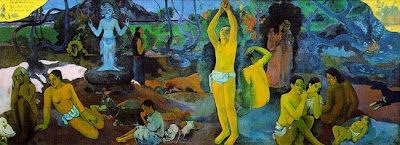
In his masterpiece Where do we come from? What are we? Where are we going? Paul Gauguin had made the everlasting quest on life and death by putting the newborn, the youth and the old woman, crying or brooding, excited or confused together on one scroll of heavy colored painting. I had a flashback of th

is piece, and couldn’t help feeling that even a genuinely talented artist like Gauguin came across pitiable when compared to Nature herself.

Nature paints the scroll of life and death every day with such beauty, cruelty and ease. Creatures such as seals don’t quest. Embodied with the rich vigor of life, they fit unawares in our world as Gauguin’s flat figures on his canvas.

Waterfall House
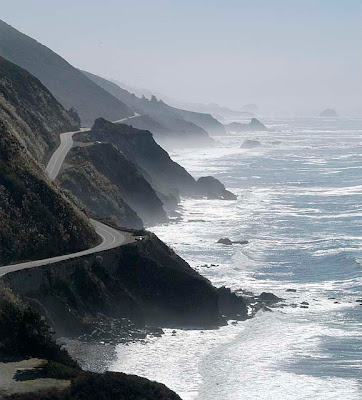
The road got curvier shortly after the Elephant Seal Beach. Hence we entered among the peaks of Santa Lucia Mountains. Mark and I started looking for a word that could rightly describe this territory -- “Stately” seemed too pretentious; “Magnificent” seemed too vague; “Lofty” failed to capture the masculinity, while saying they are merely “masculine” would have missed a very important point: these mountains were solemn and imposing: Cliff lines that plunge deep into the ocean were half veiled in a transparent mist, and valleys so shadowed by dark pine trees close in on the narrow highway at times, before abruptly retreating, revealing the vast open sea over the next turn. Santa Lucia Mountains did not come across as a hiking friendly place – not merely for safety concerns, but more because of a feeling – as if doing so is to intrude, to disturb, as if these mountains deserve more respect than that.

Even the reeds looked different. They were much tougher here than the ones growing on wet land or by ponds. Instead of bending and waving in the winds, these reeds thrust up towards the sky like disarrayed arrows and swords. They gave us a weird feeling of having stumbled upon a deserted battlefield – the blood once shed long darkened, the roar once resonated long faded, the cause once died for long forgotten, leaving behind only millions of arrows on the lonesome cliffs. Santa Lucia was, in that sense, a forlorn place. The occasional electric poles by the cliff side were the only thing that reminded us of modern inhabitation.

I’ve always wondered about those pioneers who, driven by the Homestead Acts, first ventured into this daunting wildness. What was it like to live on the cliff along the coastline, greeted by the Pacific Ocean every morning, threatened by rock slides every night? What was it like to set up ranches at a place without roads, without power, and over years hoping to prove to the state government that the land you lived on was “improved”? How many people succeeded, and how many failed?

Somewhere along the way stood a sign called Waterfall Vista, and it was here we decided to take our first stop for a walk. The trail ran parallel with a quiet creek, curving its way amidst the thick redwood forest. Then it led to a short tunnel that went underneath the highway we just drove on. At the end of the tunnel, all of a sudden, we found ourselves standing on the outside of a cliff, directly facing the ocean and the beach.

And what a beach.

It was breathtakingly beautiful, even to the eyes which had been accustomed to the grand scenes of Big Sur. Here the ocean adopted a crystal green hue, as emerald held in the sun. Huge surrounding rocks with leaning cypress and pines defined a small patch of silver sand, which gently dipped into the green water like a child’s palm. Right at one corner, an eighty feet waterfall flew down the cliff and smashed onto the beach, creating a mist that was joined, from time to time, by the foaming high tides.

The Waterfall Beach looked unworldly and delicate, as Eden looked in Paradise Lost. Right underneath the fall, I see Eve rinsing her long flowing hair, and naked Adam sunbathing by the rock at ease. If there were a place that made you forget all the mundane worries, it would be right here, on the Waterfall Beach. We stood there long at lost, on the trail that hangs on the cliff, looking down at the silver sand. The beach was inaccessible, as such an unworldly place should be.

The trail led to a platform with a couple wooden benches, and, oddly enough, the base of some piled-rock walls. The view here was splendid, with Waterfall Beach to its left, Santa Lucia valleys as its backyard, and the vast green Pacific at the doorstep. On a small peninsula now overtaken by wild cypress, I could see layers of pebbles that outlined what seemed once to be a huge garden.

Here indeed, once stood a mansion, owned by a former congressman and his wealthy wife, donated to the State of California upon his death -- for she had hoped to turn it into a museum of Indian relic -- and eventually torn down after her death.

Who is not to feel a bit empty, roaming on such a ruin? -- “For dust thou art, and unto dust shalt thou return.”

Carmel-by-the-Sea – a Nouveau Riche’s Bohemia

I have always been a fan of the Bohemian artists. Among them my favorite one is Modigliani, a young Italian painter who suffered from lung illnesses since childhood, thus forced away from his beloved sculpturing into oil painting. Throughout his life, Modigliani rarely ventured into landscape. His most famous pieces are mostly portraits.

It might have been a warm afternoon, more than ten years ago, in the huge and dusty library in Peking University. I sat there slowly flipping pages through Modigliani’s biography and portraits, greeted from time to time by necks long and thin, faces stretched and pale, eyes narrowed and yearning. The unique distortion bares resemblance to sculpturing, revealing, I thought, the painter’s own distorted yearning for the art of sculpturing.

That thought gave me a sharp sense of pain, for it reminded me of the lonely and odd life I was living. As a physics student, I never quite understood my own field, and never quite fit in scientists. What excites them always bores me deeply. For years I’ve yearned to be a writer, gulping down novels and poems at the expense of studying.

I didn’t belong to the aggressive group of overachievers of course, neither did I belong to the cool group of slackers – while they were busy partying, I was buried in the Humanity section of the library, working harder than a literature major – for nothing. Left in between the cracks of Arts and Science, I may have appeared weirder to my classmates than the distorted faces in Modigliani’s portraits.

Thus the word “Bohemian” found its way into a soft spot in my heart. I felt intimate to the concept – being a Bohemian is not about walking down a crowded street with wild hair and weird costume just so you’d appear avant-garde. Rather it’s about being different, ignored, and lonely.

Without that piercing loneliness, there wouldn’t be such a thing as Bohemian. Art is a most personal belief; it drives one into the abyss of individuality. Things that may appear crucial to others – acknowledgments, companionship and even the sense of social dignity all seem dispensable when, fortunately or unfortunately, the nymph of Art casts her gentle spell on you.

Bohemian as a trend is a ridicule to the word itself. It grew into the worst nightmare when the so-called Bohemian legacy was left among the wealthy – in a country untouched by aristocracy, where the short roots of wealth trace back to no other groups than businessmen and celebrities.

Carmel-by-the-Sea might once have been a paradise for artists with true talents; nevertheless it is a very different town now. It is one of the most expensive as well as ostentatious towns in U.S. – a Bohemia according to the nouveau riche.

Everything about Carmel was so quaint and classy: layers of gray wooden roofs dance in the arms of the redwood forest dense; numerous art galleries turned Ocean Avenue into an exquisite necklace. Along the seventeen-mile-drive lie the world’s most luxurious golf courses, while neighborhoods with dreamy backyards lead to the dog friendly beach.

Such appearance did remind me of a small European town, take Genoa for example – reclusive, subdued yet rich with history, it’s the kind of place where outcasts lead their own slow lifestyle. But then I thought of the vast golf course by the sea, and couldn’t help noticing that land here is ridiculously expensive, even to the California standard, driving hotel prices sky high and making a local store that doesn’t sell Jewels or Art impossible to afford its rent.

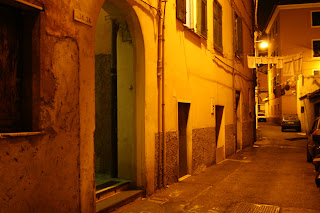
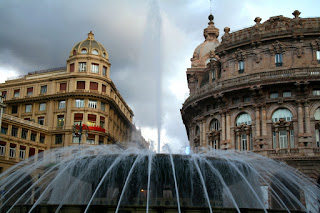
And that is not European at all, nor is it truly subdued and quiet. One of my favorite things in Genoa is to roam along the narrow alleys at night, watching doves resting on the long clothesline, and shirts and skirts waving in the soft lamplight. Deep down the alleys there often was a mixed smell of sweet climbing rose, salty fish net with a faint trace of cat pee. Those bumpy Genoa alleys connect cheap restaurants offering fresh pesto and porcini, tiny markets with local olive oil and salami before joining into Piazza de Ferrari, a grand square with more than a thousand years of history. Deep culture and vital tradition, rather than expensiveness backed up the charm of Genoa.
So, back to Carmel. How is a local artist supposed to afford living here, unless he or she has been tremendously successful already? The retired investment bankers love decorating their social life with well known artists, same way as Carmel ladies like to wear huge diamonds – in a Bohemian style that is.


Monday, October 5, 2009

Sir Hugh Lloyd-Jones


"The Greeks were not tolerant of the well-meaning idiot." --Sir Hugh Lloyd-Jones, great Classics scholar who passed away today. I met this knighted gentleman once when I was a boy in the UK, when my father was a visiting Classics professor at Oxford University. Love this quote. Full obituary here.

Friday, August 8, 2008

Ode to Melancholy ----- the Story of Lord Li


Li Yu (936-978), known as the "Lord Li", among the countless number of renowned poets and writers in the 3000 years of Chinese civilization, is my favourite one.

He was born during the time of civil wars, when China was divided into mainly 3 parts: the North, ruled by the Song Dynasty, the West, ruled by the Shu Dynasty, and the South, which covered the richest provinces both economicwise and culturewise in the country, Tang Dynasty. Li Yu, the prince of Tang Dynasty, ascended to the throne at the age of 22. Both his father and grandfather's royal tombs are still in my hometown, JiangXi, and he himself loved spending summers in Lu Shan, where one of his villas still lies.

Li Yu has been considered as the first true master of Chinese lyrical poems. Before him, lyrical poems existed as a sugary hip-pop form of literature, used mainly as love song lyrics for Geisha's performances. Li Yu was the first one to express his own feelings, thoughts, philosophy, love and pain using the form of lyrical poems, and he did it with words that are so natural, so fluently and effortlessly arranged---as if improsvised on the spot---yet so deeply moving and thought provoking, that he brought this form of literature to life. He single-handedly changed the lyrical poem from being the toy of singsong girls to being a serious art which was to dominate the Chinese literature world for the 800 years that followed.

On the other hand, his poems gave you such a vivid sense of flowing music with melodies and pauses created by his ingenious arrangements of rhymes and structures, that no other poems were preferred over his by the singsong girls as well.

Asides from the talent in literature, he was also a famous brush painter, calligraphor, Gu qin player, and book collector. There were over 20,0000 rare books in the palace of Tang, each one picked by his own eyes and notated with his own handwriting.

Lord Li was also deeply interested in the philosophy of Zen and Buddhism. He spent vast amount of time and money inviting Zen masters from all over the country for talks as well funding their endless tours and temples.

In 977, The Dynasty of Tang was defeated by the North and China was united. Most of Lord Li's collections of books and paintings were burnt down in a fire set by himself---He had planned to die with his works and pride at the news of "enemy at the gates". Before doing so, he sent away all his concubines and servants to run for their own lives, instead of making them his Majesty's sacrificial objects as the tradition at his time suggested. The only person who stayed with him was his beloved queen---Empress Zhou.

Suicide requires enormous courage, a thing this sensitive artist probably lacked. Lord Li, at the age of 39, became the prisoner of the Emperor of Song. He had to move to the North now. He was put on a boat and left his hometown, Nanking, once and for good.

Lord Li quickly received enough pain and humiliation to make one question whether a suicide earlier would have been the wiser choice ---- locked up in a small yard with his wife and a few servants, he had to dress up as a servent to wait on the Song Emperor whenever a banqeut came up, his beautiful queen was often called in by the Song Emperor for "chats" and sent back after midnight, when all he could do was sitting in his small jail-like home, drunk, waiting for her to come back.

It was during this time, when he composed some of his most famous poems. Writing was the only world left for him to hide into. This personal pain of his moved millions of souls to tears in the 1000 years to come. Nietzsche once said: Among all the words, I only love those written in blood.

Lord Li, in this sense, is indeed a lovable writer.

July 7, 978 was Chinese traditional Valentine's day. It was also Lord Li's birthday. He composed a short lyrical poem, which, in a veiled manner, lamented on the loss his country. He was drunk, and asked a singsong girl to sing this poem for him. The music spread to the nearby Palace of Song, and the lyrics offended the Emperor.Lord Li was bestowed a poisonous cup of wine which ended his 41 years of legendary life.

He was posthumously created the Prince of South by the Song Emperor. His queen committed suicide two months afterwards. And that, was the story of Lord Li.

Here comes his last poem, the one for which he unreluctantly paid his life.


Ode to Melancholy


On pedals and leaves the moon gently cast,

her endless calls for the past.

East wind sighs on and on,

alluring you with sweet memories

of the desolate hometown.


Carved balustrates and jade steps

still await thither,

'twas only your own youth

that silently withered.


How long of a way does melancholy go?

Just like a river,

to the east it forever flows.


Sweewawa

Saturday, June 7, 2008

The Rice pudding and Qu Yuan

---- in memory of the Duan Wu Festival


One of my earliest memories has to do with rice pudding. When I look back upon my childhood, there is a hint of the faint scent of bamboo leaves in almost anything I can remember. Peel off those dark green leaves with thin ropes around them and the white, jade-like sweet rice with a spell of inviting smell would appear in front of your eyes. Sometimes I think it’s all the fun from my childhood memories as well as the rice puddings that are wrapped in those leaves.

The time to eat rice puddings comes once a year, on the Duan Wu Festival, also referred to as the Dragon Boat Festival. Growing up in the city, I never associated with that name. I never saw any dragon boats with my own eyes anyway. Many years passed, numerous rice puddings with different fillings---mung beans, sweet beans, pork, etc were consumed before suddenly, on one Duan Wu Festival, right after I unwrapped a rice pudding and was busy licking my sticky fingers, a thoughtful question came to my mind:

“Dad, why do we make rice puddings on Duan Wu Festival again? I mean, I know the legend says you’re supposed to throw them into the river to feed the fish----isn’t that kind of odd?”

“So the fish wouldn’t eat the body of Master Qu Yuan.” said my Dad.

It turned out that I had sadly missed the whole point of this festival. It is a festival in memory of one of the greatest poets in Chinese history, but I hadn’t even heard of his name after consuming 80 rice puddings at the very least.

Qu Yuan lived during the Warring States period, when China was split up into seven states, and died around 270 BC or so --- about 200 years later than Confucius. His contribution to Chinese folksongs and poems are as unique and huge as that of Homer to the Greek epic. But, instead of being a blind lyric poet, Qu Yuan descended from the royal house of Chu (one of the states during the Warring States Period), served in high offices and was a political activist until his exile.

Qu Yuan foresaw the danger of Qin (another state) and strongly opposed the alliance with the state. Those who read Chinese history know that in another 50 years or so, Qin would finish conquering all the other 6 states and unite China, but people around Qu Yuan had no way to tell. The young scholar-official placed his pride and integrity above everything else, which unfortunately made him an unsuccessful politician. It wasn’t long before he became the target of slander from the corrupt and timid ministers who voted for allying with Qin around him. His most loyal counselor was banished and he himself was exiled.

The exile must have been a most depressing experience for Qu Yuan, but Chinese culture benefited from it. It was during this 10 year long trip the sad scholar collected numerous folksongs from the towns and villages south of the Long River, organized them into verses with high literature values, and wrote many narrative poems himself expressing his fervent love for his state and his deepest concern for her future.

These works are some of the earliest scholarly poems in Chinese history. They paved the way for poem development in the 2000 years that followed, set the tone for all the beautiful haiku that were to appear, as well as reaching the peak of narrative epic, a position that’s not to be challenged in the entire Chinese literature history.

But the poet remained an innocent fellow. For, you see, an innocent soul is the number one necessity for poetry.

A best illustration of his innocence is the story the fisherman. Qu Yuan wondered to a river and met a fisherman hermit by the bank one day. His long white robe had mud stains on the bottom and curved hem on the edge. A gust of wind blew across the river, bringing the mixed smell of fishes and wet grass as well as boat songs from the distant islands. His wide sleeves and loose sash rose with the wind, his white jade ornament that hung from the sash jingled accordingly. He was tired and curious as he had always been during the trip, he started a conversation with the fisherman.

They talked about his unfulfilled dreams, his loyalty for the King, and his unfair exile. “So why don’t you let go of yourself and drift with the waves?” Said the fisherman on the boat.

But the poet could not. Whether he WOULD not, or COULD not, we don’t know----maybe both. “The entire world is drunk, I am the only one sober. The entire world is filthy, I am the only one clean.” was his reply. He refused to join the current, let go of his own beliefs and drift in the waves.

I found this story to be a very symbolic image. You stand by the river of life, watching the gigantic trend carrying away millions of souls, trying to decide whether you should jump in and join them, or stand by as a lonely observer. The river Qu Yuan once stood by runs through ages, runs across all nation’s history, runs nonstoppingly past our feet. It is that same river that Copernicus once stood by, pondering on whether the Earth circles around the Sun; It is the same river that Monet once stood by, trying to capture the beauty of a sunrise in a “impressionistic” way that is to be blamed by every single art critic in Paris; The main character in Romain Rolland’s novel Jean Christophe, Olivier, once saw the French social trend in his time as river, how he was thrilled by the workers’ strikes, how he was curious about the socialism movements, but he could not join in. All he could do is to stand on the bank, watching the river flowing past him, with its angry waves smashing the bank and wetting his shoes.

Thinking about all these people, I started to understand Qu Yuan more. He was a loner in his time, abandoned by his contemporaries. The trend of culture would not accept him, the drinking party would not accept him. He stood by the noisy river, lonely and sober. He was both doomed and blessed for that.

He pondered and reflected too much. He would often take long walks by a well, look upon his reflection in the water and be his own person, thin and gaunt. His intimate relation with water ended in an ultimate tragedy.

In 278 BC, just as he foresaw, his home state, Chu was eventually conquered by Qin. He felt that he should pay his last respect for his hometown, for a culture that he long loved with both his political passion as a minister and his 10 years of folksong collection as an exile.

He arranged a simple yet beautiful ceremony, a sacrifice to the lost Chu culture during which his was to offer his own life. He waded into the Miluo River with a big stone tied to himself.

Then comes the origin of the rice puddings and dragon boats. Local people rushed to save him, which later became the ceremony of dragon boats competition. But the scholar disappeared in the endless waves, not a shoe of him was found. People made rice puddings and threw them into the river, saying to the fish----please do not eat our beloved poet and minister.

Qu Yuan’s story ended in water. He was carried away by the waves at last. But I would like to think, that it was only his body that was carried away. He left his flesh to the blind trend, and kept his soul for himself, in the reflecting well.

Whether the king of Chu conquered Qin, or the king of Qin conquered Chu made no difference to our lives in two thousand years. Even the hometown of Qu Yuan, Zi Gui village by the Three Gorges, went under water after the dam was built. The river of life is powerful, it washes away everything, pointless or memorable.

If you are not a fan of ancient poems, the only trace Qu Yuan had left that you would know about is the rice puddings. I started eating rice puddings by the age of 3 or 4, and did not care much about Qu Yuan until high school. Splendid stories of the ancient heroes, they inevitably fade away and morph into the mundane life.


Dr. Sweewawa